 info@rushtranslationservices.com
 +1-559-742-0021
Understanding Certified vs. Standard Translation is key to choosing the right service. A translation that comes with a Certificate of Accuracy is considered certified. This is a signed statement from the translator, which adds official validation. This is essential for purposes like USCIS submission, legal proceedings, etc. On the other hand, standard or regular translations are non-certified translations.
These are ideal for general purposes where conveying meaning is the key goal. In this article, we will discuss these two types of translations in detail. We will also discuss their use cases and requirements, highlighting their key differences. Keep reading to know the right option for you!
Key Takeaways
- Normal translations are not legal, but certified ones are.
- A Certificate of Accuracy is an indispensable requirement for government and official use.
- Certified copies are needed by immigration, legal, academic, and regulatory organizations.
- Certified translations are more precise than flexible in text and format.
- Submitting regular translations for official use leads to rejection and legal implications.
Certified vs Standard Translation: A Quick Glimpse
Here’s a table explaining the main difference between certified translation and standard translation:
| Certified / Official Translation | Standard / Non-certified Translation |
| Translation is accompanied by a Certificate of Accuracy | Does not come with a signed certificate |
| Legally binding and accepted by government agencies and authorities | Does not have official recognition or legal validity |
| Only provided by professionally licensed translators | Anyone can provide. Yet, hiring experts is highly recommended to ensure a higher level of accuracy |
| Ideal for legal, official, academic, immigration, government, contract, and administrative uses. | They serve different purposes for general communication needs. Their goal is to bridge the language gap. |
What Is a Certified Translation?
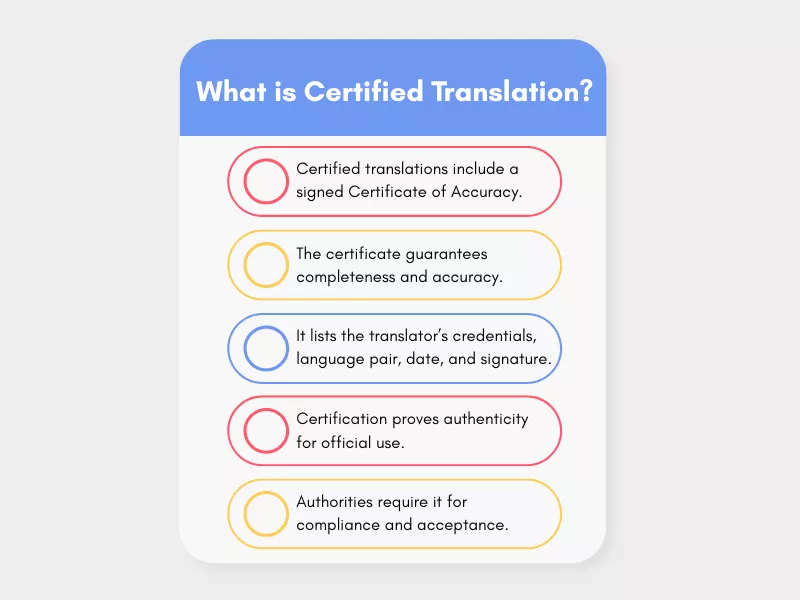
As the name suggests, Certified Translation comes with a formal certification. This is commonly known as “Translation Certificate of Accuracy”. This COA includes a signed statement of a qualified and professionally licensed translator who provided the translation. It affirms that the translated copy is a complete and precise rendering of the original text. This Official document translation also includes
- The translator’s or agency’s contact details
- Professional qualifications
- The language pair
- The date and a signature
This official certification is important for three reasons:
- Translation authenticity verification for the document for legal or official purposes.
- Ensuring translation is compliant with authoritative requirements for acceptance.
- To affirm that the translation process has met the highest standards of accuracy
Now the question comes, when certified or official translations are required. Also, which documents generally needs translation certificate and who demands it for acceptance. Below is a table that answers all the doubts:
Necessity of Certified Translation: Use Cases, Authorities & Documents
| When Do You Need a Certified Translation? | Authority Bodies | Documents Requiring Translation Certificate |
| Meeting USCIS certified translation requirements | U.S. Citizenship and Immigration Services (USCIS) |
|
| Academic Admissions |
U.S. Universities/Colleges Educational Institutions Credential Evaluators (e.g., WES, ECE, NACES) |
|
| Legal and jurisdiction Proceedings |
State and Federal Courts Department of Justice (DOJ) |
|
| Professional Licensing |
State Regulatory Boards (e.g., State Medical Boards, Board of Nursing) |
|
| Translation for visa application & Employment |
Department of Labor (DOL) Social Security Administration (SSA) |
|
| Financial & Banking |
Internal Revenue Service (IRS) U.S. Banks Mortgage Lenders |
|
| Healthcare & Insurance |
U.S. Hospitals FDA Insurance Providers |
|
| Business & Regulatory |
Securities and Exchange Commission (SEC) Secretary of State |
|
| Governmental Benefits |
Social Security Administration (SSA) State Social Services |
|
| International Travel | U.S. Department of State (for Passports/Visas) |
|
Standard Translation Definition: What is it?
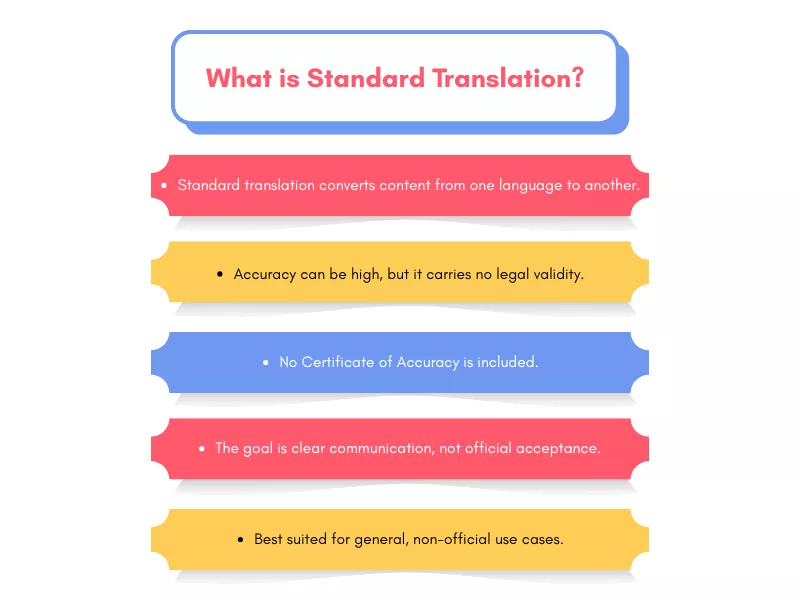
Standard Translation refers to the process of converting text from one language to another language (source language → target language). If done by an expert, the accuracy and precision are often 100% guaranteed.
However, regular translations lack legal validity. They do not accompany any formal certification. So, they are not government accepted translation. The main objective is to deliver the original message in the audience’s language. Bridging the understanding gap is the main priority. Therefore, use cases include general purposes where official recognition or legal validation is not required. In fact, many look for ways how to become a literary translator. But they need to understand that literary translations are more difficult than they seem.
Common Use Cases of Regular Translations
- Corporate Internal Uses & Business Communications (e.g., company-wide memos, policy updates, internal reports, etc.)
- Marketing Content (e.g., web content, blog posts, social media content, and digital advertisements)
- E-commerce content (e.g., product descriptions, online catalogs & customer reviews).
- User Manuals and Technical Guides (e.g., booklets, FAQs, and “How-to” guides).
- Personal Correspondence (e.g., letters, emails, or personal greeting cards).
- Educational content (e.g., non-official training modules, presentations, & webinar transcripts).
- Informational Research (e.g., foreign news articles, industry reports, or academic journals).
- Travel and Hospitality Information (e.g., menus, hotel brochures, city guides, and travel itineraries).
- Media and Creative Content (e.g., video subtitles, books, non-commercial play scripts, and drafts).
5 Key Differences Between Certified and Standard Translation
Understanding translation type matters when preparing important documents. Certified and standard options serve different practical purposes. The subsequent sections elaborate on the major dissimilarities clearly.
- Format: Certified copy is an exact copy of the original format. This is important for embassy document translation verification. The standard option can be flexible in terms of layout depending on the medium of delivery.
- Purpose: The translation certification has legal status in submissions that are official. Certified documents are necessary when the accuracy and completeness of translation material are crucial to ascertain authenticity and truthfulness. One example is: Court-approved translation needs to be certified. Standard option suits individual, informational, informal, and business translation services needs.
- Professionalism: Translations with certification include signed statements and official provider stamps. These aspects attest to authenticity and professional accountability criteria. Regular translation lacks it.
- Accuracy: Certification prioritizes precise wording identical to the originals. Regular translations emphasize clarity and natural meaning flow.
- Formality: Certified document translation is formal and is based on legal standards. Immigration document translation requires such compliance. Standard process adjusts tone based on client context.
What is the Risk of Using General Translation for Official or Legal Purposes?
Using an uncertified translation for official purposes leads to severe consequences, such as:
- Blatant refusal: Government accepts only certified copies. A Notice of Intent to Deny (NOID) may be issued against you for not meeting legal translation requirements, or you may be denied a visa or other benefit on the spot.
- Financial Loss: You will have to choose resubmission with a certified translation. This will come at an additional cost. In addition, government fees are not usually refundable even after rejection.
- Unnecessary Delays: The rejection usually stops the process that takes several months. This results in lost opportunities such as
- Employment start dates.
- Deadlines in university admissions.
- Family emergency and business travel.
- Legal Implications: In legal proceedings, a general translation is “unverified hearsay.” The judges can declare the document inadmissible for not meeting Translation compliance requirements. This may result in the loss of a lawsuit or the invalidity of a contract.
So, standard translated documents are for general use. These are not for official or legal purposes. You have to hire a qualified professional to meet official Translation quality standards. Only they can offer official certification for official document translations. They use machine translation post-editing process to ensure the translations are accurate.
Certified vs Non-certified Translation: How to Choose the Right One?
Choosing the right foreign born birth certificate translation service is entirely dependent on two factors. This include type of document and the scope of usage. Go for certified solutions for the documents to be used in official and legal matters. For generic purposes without official or administrative review, regular translations work well. These translations suit everyday needs and informal document use.
In the end, understanding the differences between standard and certified translations matters. This knowledge helps you make informed and confident decisions.
No matter your translation needs, choosing the right provider is essential. Rush Translation Services offers certified and standard translations across the USA. You can hire qualified, professional translators for varied requirements.
Their ISO certified translation services deliver high accuracy with a 100 percent acceptance guarantee. For standard needs, experts preserve cultural and contextual meaning carefully. Contact our translation agency and access the right expertise!
Frequently Asked Questions
Q1. Can I translate my own documents and certify them myself?
No! You can not translate your own documents and certify them. Only qualified and professional translators can do that. Plus, self-translated documents face outright rejections.
Q2. What is a notarized translation, and do I need it in addition to certification?
A notarized translation is also a certified and signed translation. It additionally include notary’s signature and official seal. The notary confirms the translator’s identity only. It does not verify the translation’s accuracy. You usually need it only when institutions request it. This applies to academic transcripts or foreign documents.
Q3. Why does a certified option cost more than a standard one?
Certifying a translation costs more due to expertise and liability. They require accuracy verification and often include signed certificates. The process involves formatting, proofreading, and handling official documents.
Q4. Do translation certifications ever expire?
Generally, no. A certification remains valid as long as the original document is legally valid.

