 info@rushtranslationservices.com
 +1-559-742-0021
You have a great product. You launched a website. But your bounce rate is increasing even before the customer scrolls. Here, the problem is not your product. It is your website which speak to the customer in a voice that they don’t understand.
Simple translation just converts your texts. On the other hand, website localization puts your experience in a different market. The website localization benefit are a reason businesses are reaching global audiences. In this blog, we will discuss the real-world examples of how these benefits worked for the leading brands.
Key Takeaways
- Localization ≠ Translation- Both are not the same. Localization adapts to the language, culture, etc., to make your site feel native.
- Drives Revenue- 76% of consumers prefer buying in their native language. Proper localization can boost revenue significantly.
- Improves Full-Funnel Performance- It improves search visibility at all levels.
- Boosts SEO & Brand Trust- Hreflang tags, localized metadata, and region-specific content improve search rankings. It builds genuine credibility with local audiences.
- Plan Early or Pay Later- Doing localization on an existing site is costly. Building with internationalization (i18n) principles from the start saves significant time and money.
What Is Website Localization?
Website localization is the process of personalizing your website so that it feels native to a specific local market. It is not restricted to linguistic requirements. It also includes cultural and experience adaptation.
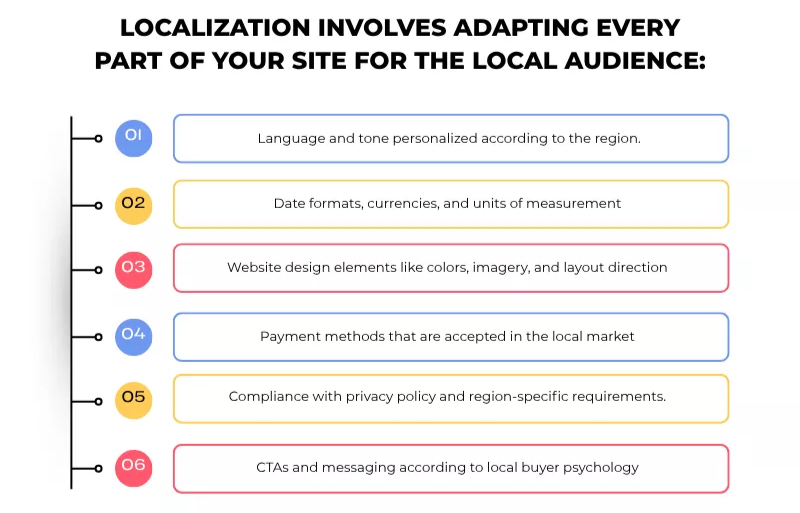
Website Localization vs. Website Translation
Website translation and localization cannot be used interchangeably. When you are building a serious website localization strategy for international growth, make sure you know the difference:
Language translation is converting text from one language to another. The layout, imagery, UX, and checkout all remain the same across every market.
Localization is different in terms of experience. Language translation simply cannot address it.
An e-commerce brand trying to expand to Japan does not need Japanese text. It needs product photography that shows compact living spaces. It should include a checkout layout that supports local payment methods and a customer service tone that matches the norms. That’s localization, not translation.
Key Benefits of Website Localization
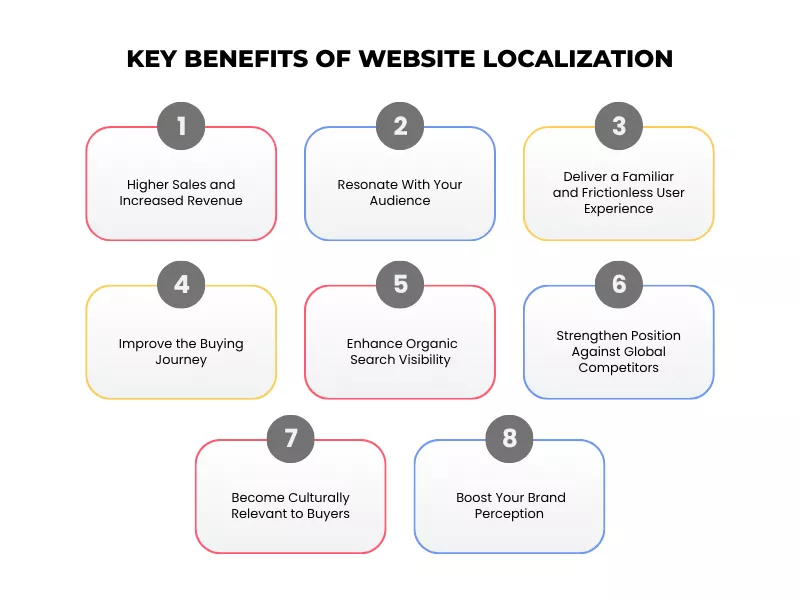
There are several advantages of website localization. It goes far beyond any translation tool. Here are the real-world examples:
1. Higher Sales and Increased Revenue
When customer get information in their own language, they feel comfortable and confident while buying the product.
According to CSA research, 76% of consumers prefer purchasing products with information in their native language. 40% won’t buy at all from websites in other languages.
Localization can help remove the friction that kills conversions. Duolingo did it well.
They did not just translate the app; they adapted it to the user experience for each market. In Japan, they found that new users felt anxious about placement tests; the word test caused a lot of stress. They redesigned the onboarding flow for them.
Similarly, in China, they added WeChat as a login option to eliminate sign-in issues. This increased their revenue by 30% and compelled 8 million new users to download the app.
2. Resonate With Your Audience
One of the main challenges to grow your business is driving traffic to the website. The key advantages of localizing your website in 2026 are that it boosts conversion rates.
Coca-Cola’s ‘Share a Coke’ campaign is the best example of how you can make a global brand feel local. In Australia, they used terms like ‘Mate’ and ‘Buddy.’ In the US, this localized approach gave 11% sale increase as it connected with young buyers.
This way, your website speaks the way your audience thinks. This cannot be done alone by translating text. Use the benefits of localizing web content and see results.
3. Deliver a Familiar and Frictionless User Experience
User experience is based on familiarity. When a visitor opens the website, and it behaves in the way they want, they simply browse it. Localization makes the website native by adapting your website design to match what local users already know.
Website localization and conversion rates go hand in hand. This is how sustainable global growth takes place. This strategy was followed by Looklet. They adapted product imagery based on visitor location.
A user from Texas sees shorts and sundresses in hero images. At the same time, Swedish shoppers see long sleeves and knitwear. It makes the visitor feel that the site was built for them.
4. Improve the Buying Journey
Localization not just fixes one touchpoint, it lifts every stage of the buying journey. This is one of the top benefits of website localization for small businesses. You get a full-funnel advantage. Here’s how:
Top of the Funnel
The multilingual website benefits are too much to handle. It is more visible in local search and gets more website traffic and a better customer experience. More website traffic from the target audience gets you leads.
Middle of the Funnel
At this stage, the visitor evaluates you and your website content. Localized content helps in building credibility with the local audience. When potential customers see social proof in their own country, it gives them validation to choose you.
Bottom of the Funnel
This is where localization does its work. Here, buyers need:
- A simplified refund and shipping policy is explained in the local language.
- Pricing given in their local currency
- Payment methods they actually use in their region
- Region-specific trust signals that remove last-minute doubt
5. Enhance Organic Search Visibility
This is the most overlooked website localization benefits for international SEO. Search engines prioritize content that is relevant to the target market.
Effective website localization for international SEO needs:
- Hreflang tags that correctly signal language and region to search engines
- Region-specific URL structures (e.g., /de/, /fr/, /in/)
- Localized metadata like titles, descriptions, and image alt text
- Content targeting keywords that people in each local market actually search for
- Local backlinks and citations that build domain authority in that market
Professional online translation services remain essential for high-stakes content: legal pages, product descriptions, and campaign copy. The gap between machine translation and professional localization shows most clearly in the content your buyers read right before deciding whether to trust you.
6. Strengthen Position Against Global Competitors
Entering a new market and getting leads are two different things. But when you invest in website localization, you do more than what translation does. Localization ensures the customer knows you actually care for them. Nintendo, a Japanese company, did it right.
It did not just translate the dialogue and menus. It rewrote jokes to land in the target market. It renamed the characters, which builds the emotional connection in Germany, Brazil, and the US, as they do in Japan.
This is how effective website localization for business growth converts market presence into market position.
7. Become Culturally Relevant to Buyers
Global brands that do not give much attention to cultural nuances experience the disadvantages later. When you localize a website, you go beyond surface-level adaptation. This is known as glocalization. It makes sure your entire website is designed to feel natural and right for a new market.
When your brand becomes culturally relevant, it starts to feel human-like. This difference drives emotional trust.
8. Boost Your Brand Perception
Have you heard that first impressions are the last impressions? It is true. A website that’s just auto-translated shows carelessness. Effective localization shows genuine investment and respect.
Improving customer trust through website localization is one of the most direct, measurable outcomes businesses see after going multilingual. When visitors don’t have to mentally translate, convert prices, or second-guess whether your brand is relevant to them, the experience feels premium before they even see the product.
Localization helps in building trust. It makes every part of your website work.
3 Website Localization Challenges to Prepare for
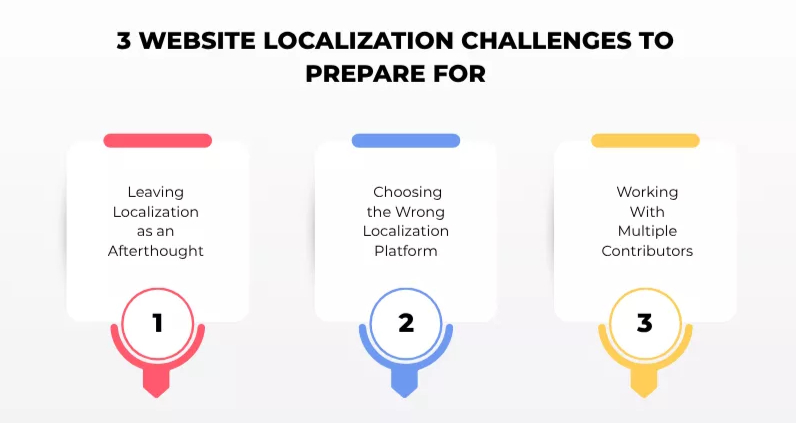
The benefits of website localization for global reach are clear. But going in without preparation amplifies the cost and the risk. Here are three challenges that catch most businesses off guard, and how to explore them.
1. Choosing the Wrong Localization Platform
A website localization project includes many parts in different languages and regions. Without the right infrastructure, localization does not work properly. Quality drops, and your audience notices.
A strong localization tool or platform should have:
- Direct integration with your CMS pipeline
- Translation memories that enforce consistency across your entire website
- AI-powered localization to accelerate high-volume content localization
- Clear role assignments and workflows for multiple contributors
- Version control to manage updates across all languages and regions
When you choose the right localization service partner to localize your website, the entire localization process becomes systematic rather than chaotic. Professional localization services bring human expertise to the cultural and tonal decisions that tools alone can’t make well.
2. Leaving Localization as an Afterthought
The biggest mistake while doing localization is building your whole website in one language.
When your website design does not adapt to text expansion (German runs 30% longer than English), right-to-left scripts, or flexible UI components, localizing it later will mean making it from scratch.
- Make your website from the start.
- Understand what your localization needs are before the first line of code is written.
- Apply internationalization (i18n) principles: externalize all text strings, build flexible layout components, and design with multiple languages and regions in mind.
Localization technology today, including AI-powered localization tools and modern localization platforms, integrates directly into your CMS and development workflow. This makes it easier to build for multiple markets without starting over later.
3. Working With Multiple Contributors
When localization efforts work, the contributor list also scales. It includes all translators, brand managers, etc.
Without a structured workflow, things get lost. Errors compound through every stage of the localization process. And catching a mistake after it’s live across your entire website in a new market is both costly and damaging.
Teams that manage localization across multiple markets with a dedicated translation management system are important. It centralizes translation memories, glossaries, contributor workflows, and version control, so every part of your localized website user experience stays consistent, current, and on-brand.
The Bottom Line
Frequently Asked Questions
Q1. How do website localization benefits impact SEO rankings?
Localized website shows better results. Google prefers websites that match the intent of local visitors.
Q2. Can website localization increase conversion rates and sales?
People buy more when a website feels familiar to them. If they see their language, currency, and local examples, they trust the site more and are much more likely to complete a purchase.
Q3. What role does cultural adaptation play in website localization benefits?
Using the right colors, images, and tone for a specific culture makes people feel comfortable and connected to your brand.
Q4. Is website localization worth the investment for small businesses?
Yes, even for small businesses. You don’t need a huge budget to start. Reaching even one new market in their own language can bring in new customers and grow your revenue noticeably.

