 info@rushtranslationservices.com
 +1-559-742-0021

Walk into a Bangkok market, a Chiang Mai temple, or a Thai restaurant anywhere in the world, and one phrase will open more doors than any other: ขอบคุณ (khop khun). It takes thirty seconds to learn how to say thank you in Thai, and it rewards you with smiles, warmer service, and the kind of cultural connection that no guidebook can buy.
There are formal and informal ways to say thank you in Thai, and the right one depends on who you’re speaking to and where you are. This guide covers all of it: the Thai script, correct pronunciation, the gender particles that make you sound polished, and the cultural moments where words alone aren’t quite enough. Whether you’re a first-time traveler or someone on a deeper Thai learning journey, knowing how to say thank you in Thai language correctly will set you apart from the crowd.
Key Takeaways to Say Thank You In Thai
- You’ll see “khop khun kha” and “khob khun kha” used interchangeably online.
- When Thai people omit ครับ/ค่ะ with each other, it signals intimacy or equality. When foreigners drop it, Thais usually chalk it up to inexperience.
- The phonetic borrowing of “thank you” into Thai script isn’t lazy; it’s a fully absorbed expression with its own cultural life.
- More than any thank-you phrase, this reply: “it’s nothing”, reflects a deeply ingrained social value of not burdening others with obligation.
- A close friend who saves you from a serious situation deserves ขอบคุณมากครับ/ค่ะ, not just ขอบใจ.
The Core Phrase: ขอบคุณ (Khop Khun) – What It Means and When to Use It
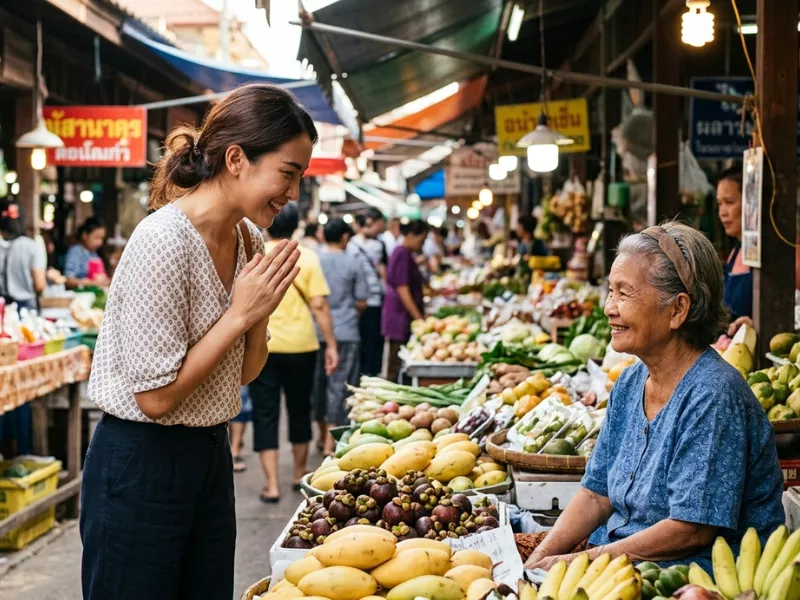
The base phrase for thank you in Thai language is ขอบคุณ, romanized as khop khun. On its own, it’s perfectly understood, similar to a casual “thanks” in English. You’ll hear it everywhere: markets, taxis, restaurants, and offices.
If you’ve searched khop khun krap meaning in Thai, here’s the direct answer: it means “thank you” spoken by a male speaker, where krap (ครับ) is the polite particle that signals respect and good manners.
The word breaks down simply:
| Thai | Romanization | Pronunciation | Meaning |
| ขอบ | khop | “kawp” (low tone, short) | (in this compound) — to give thanks for / to acknowledge |
| คุณ | khun | “khoon” (mid tone) | you / virtue / a polite title |
Together, ขอบคุณ literally means something close to “I appreciate you.” That warmth is built right into the language.
How Do You Pronounce Thank You in Thai Correctly?
This section is your Thai thank you phrases with a correct pronunciation guide covering tones, syllable breakdown, and the polite particles.
Thai is a tonal language with five tones. Mispronouncing a word doesn’t just sound odd; it can change the meaning entirely. Don’t panic, Thai isn’t the hardest language to learn, but tones do take a few tries to get right.
You may also see this spelled as khob khun. The pronunciation in Thai follows the same tonal rules as khop khun. The “b” and “p” at the end of the first syllable are both valid romanizations of the same Thai sound (an unreleased stop). So whether you’ve read khop or khob, you’re saying the same word.
Note: You’ll also see this written as khàawp khun (with tone marks showing the long vowel and low tone). In this guide, we use khop khun for simplicity, but khàawp khun is the more acoustically accurate form; it’s what the 1-ranked Thai language resources use, and it helps you hear the long “aw” vowel.
Here’s the tone breakdown for the two syllables in ขอบคุณ:
| Syllable | Thai | Tone | How to Approximate It |
| khop | ขอบ | low | Start below your natural pitch and keep it flat and short |
| khun | คุณ | mid | Stay at your natural speaking pitch, flat, neither rising nor falling |
A common beginner mistake is saying both syllables in a flat, even tone. The result still gets the message across, but it sounds stilted to Thai ears.
Keep khop low and short, then keep khun level and flat, and you’ll sound noticeably more natural. A common mistake is letting khun rise at the end like a question; resist that urge and keep it steady. Such complexities arise when you move to an international country and want the translation of your documents. In such cases, you need the help of translation services to provide accurate solutions.
For the polite particles added at the end:
- ครับ (khráp) – high tone, used by males. The “r” sound is often dropped in casual speech, so you’ll frequently hear it as khap.
- ค่ะ (khâ) – falling tone, used by females. In questions, this shifts to a high tone and becomes คะ (khá).
Khop Khun Krap vs. Khop Khun Ka: What’s the Difference?
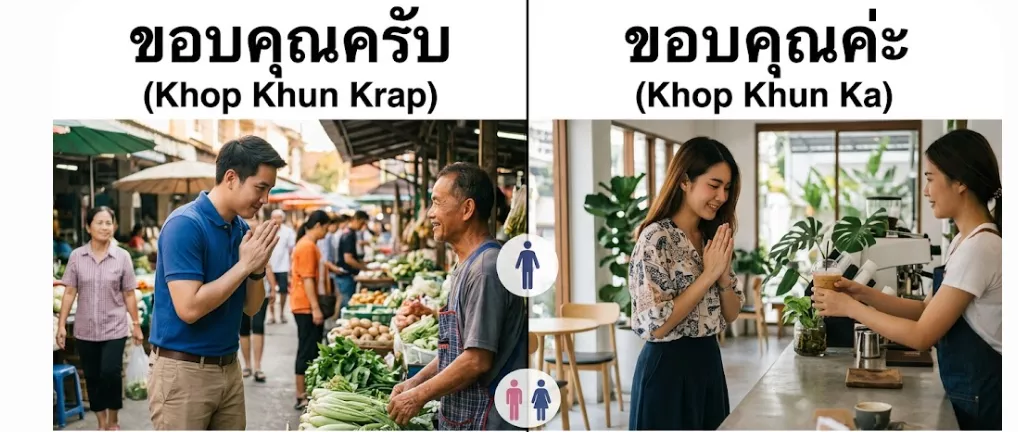
The difference is entirely about the speaker’s gender, not the listener’s.
| Phrase | Thai Script | Pronunciation | Speaker | Formality |
| Khop khun khráp | ขอบคุณครับ | “kawp-khoon-krap” | Male | Polite, everyday |
| Khop khun khâ | ขอบคุณค่ะ | “kawp-khoon-kaa” | Female | Polite, everyday |
So, when you ask Is there a difference between khop khun krap and khop khun ka? The key thing to remember is that the particle reflects your gender, not the gender of the person you’re thanking. A woman thanking a man still says ขอบคุณค่ะ. A man thanking a woman still says ขอบคุณครับ. This trips up many learners early on, and it is the beauty of Thai tradition.
Thank You Very Much in Thai Language: Adding มาก (Mâak)
To intensify your gratitude and say thank you very much in Thai, insert มาก (mâak, meaning “very” or “a lot”) before the polite particle, not at the very end.
| Phrase | Thai Script | Pronunciation | Speaker |
| Khop khun mâak khráp | ขอบคุณมากครับ | “kawp-khoon-maak-krap” | Male |
| Khop khun mâak khâ | ขอบคุณมากค่ะ | “kawp-khoon-maak-kaa” | Female |
The placement matters. Saying ขอบคุณครับมาก (moving mâak after khráp) sounds unnatural. Keep the order: ขอบคุณ + มาก + particle.
Use this form whenever someone has genuinely gone out of their way, helped you navigate, covered your cab fare, or done something unexpected.
Formal Ways to Express Gratitude in Thai Culture
In professional settings, with elders, or during ceremonies, there is a more elevated expression:
ขอบพระคุณ (khop phra khun) – the addition of พระ (phra, a word meaning sacred or holy, used for monks, Buddhist objects, and royal contexts) lifts the phrase to a formal register.
| Phrase | Thai Script | Pronunciation | Context |
| Khop phra khun khráp | ขอบพระคุณครับ | “kawp-pra-khoon-krap” | Formal, male speaker |
| Khop phra khun khâ | ขอบพระคุณค่ะ | “kawp-pra-khoon-kaa” | Formal, female speaker |
| Khop phra khun mâak khráp/khâ | ขอบพระคุณมากครับ/ค่ะ | “kawp-pra-khoon-maak-krap/kaa” | Deep formal gratitude |
You’d use ขอบพระคุณ in structured professional or ceremonial settings, a boardroom, a speech, or a formal letter of thanks. It signals that you understand Thai social hierarchy – and Thai people notice.
Situation-by-Situation Guide: Which Thai Gratitude Phrase to Use
| Situation | Recommended Phrase | Thai Script | Pronunciation |
| Thanking a cashier or vendor | Khop khun khráp/khâ | ขอบคุณครับ/ค่ะ | “kawp-khoon-krap/kaa” |
| Thanking a friend your own age | Khop jai (see informal section below) | ขอบใจ | “kawp-jai” |
| Thanking a boss or senior colleague | Khop phra khun mâak khráp/khâ | ขอบพระคุณมากครับ/ค่ะ | “kawp-pra-khoon-maak-krap/kaa” |
| Someone helps you in an emergency | Khop khun mâak khráp/khâ | ขอบคุณมากครับ/ค่ะ | “kawp-khoon-maak-krap/kaa” |
| Thanking someone for a meal they cooked | Khop khun samràp ahǎan | ขอบคุณสำหรับอาหาร | “kawp-khoon-sam-rap-a-haan” |
| Receiving a gift | Khop khun samràp khǎwng khwǎn | ขอบคุณสำหรับของขวัญ | “kawp-khoon-sam-rap-kawng-khwan” |
| Thanking someone for their kindness | Khop khun samràp khwaam mii náam jai | ขอบคุณสำหรับความมีน้ำใจ | “kawp-khoon-sam-rap-khwaam-mee-naam-jai” |
Beyond the situational guide above, Thai learners and travelers often need to thank someone for something specific. Here are the most-searched “thank you for…” phrases, each ready to use:
| English | Thai Script | Romanization |
| Thank you for your help | ขอบคุณที่ช่วย | khop khun thîi chûay |
| Thank you for your time | ขอบคุณสำหรับเวลา | khop khun sǎm-ràp wee-laa |
| Thank you for everything | ขอบคุณสำหรับทุกอย่าง | khop khun sǎm-ràp túk yàang |
| Thank you for understanding | ขอบคุณที่เข้าใจ | khop khun thîi khâo-jai |
| I really appreciate it | ซาบซึ้งใจมาก | sâap-séung jai mâak |
Common Mistakes Foreigners Make When Saying Thank You in Thai
Thai people are gracious about language errors, but knowing the common traps will help you sound more natural from day one. Here are the mistakes most often made by travelers and language learners:
- Using the wrong gender particle: A man saying ค่ะ (khâ) or a woman saying ครับ (khráp) sounds jarring to Thai ears. The particle reflects your gender as the speaker, not the gender of the person you’re thanking.
- Pronouncing both syllables in the same flat tone: ขอบ (khop) must be low and short; คุณ (khun) stays mid and level. A flat, monotone delivery still communicates the meaning but loses the natural Thai rhythm.
- Using ขอบใจ (khop jai) with elders or bosses: This casual form is reserved for peers and close friends. With anyone older or in authority, it can come across as dismissive, even rude. Stick to ขอบคุณ (khop khun) with the appropriate particle.
- Returning a wai to cashiers or service staff. When a cashier or waiter wais you, they’re performing a workplace greeting, not asking for a deep bow in return. A warm smile and a nod are the culturally correct responses. Wai-ing back can actually create awkwardness.
- Placing มาก (mâak) after the polite particle. The correct order is ขอบคุณ + มาก + particle (e.g., ขอบคุณมากครับ). Saying ขอบคุณครับมาก, putting มาก after ครับ, sounds unnatural and slightly confusing in Thai.
Informal Ways to Say Thank You in Thai: Among Friends and Peers
When you’re with close friends, younger people, or in a relaxed setting, the formal khop khun khráp/khâ can feel stiff. Thai has casual alternatives that locals use all the time.
ขอบใจ (Khop Jai) – The Casual “Thanks”
Khop jai is the go-to informal thank you. The word ใจ (jai) means “heart” – so there’s a poetic undertone of “my heart appreciates you.” In practice it’s just relaxed slang.
Important caveat: don’t use khop jai with someone older than you, your boss, or anyone in a position of authority. It can come across as dismissive.
To soften it slightly, add นะ (na) at the end:
- ขอบใจนะ (khop jai na) – “Thanks” with a friendly softener
Women sometimes add จ้ะ (jâa) instead:
- ขอบใจจ้ะ (khop jai jâa) – casual female form
แต้งกิ้ว (Dtâeng Gîw) – The Playful Transliteration
This is simply “thank you” borrowed phonetically from English and written in Thai. It’s used a lot, especially in texting, among younger Thai people, and in light-hearted exchanges. Don’t be surprised or feel odd using it. Thais use it all the time themselves.
The Wai Gesture: When Saying Thank You in Thai Isn’t Enough
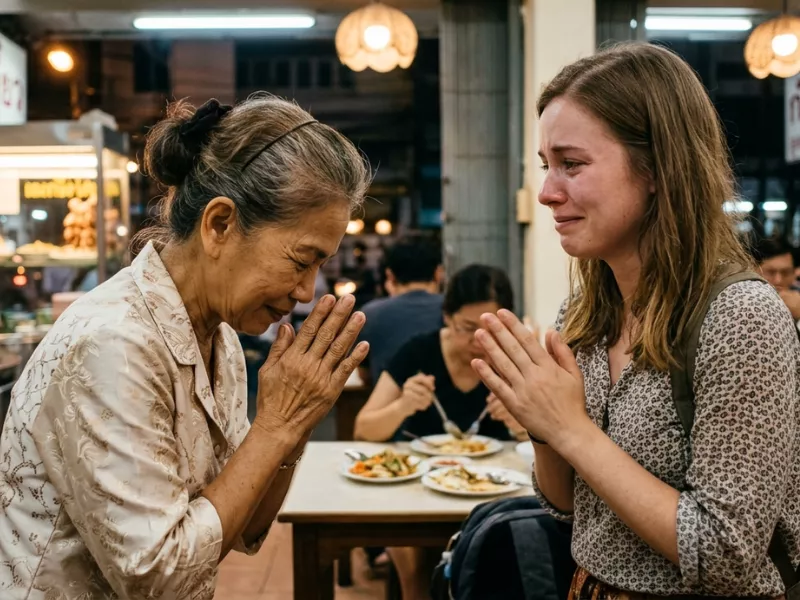
Language only goes so far in Thai culture. Even when you know how to say thank you in Thai perfectly, some moments call for more than words. The ไหว้ (wai) gesture, pressing both palms together at chest level, fingertips pointing up, with a slight bow of the head – is the physical counterpart to spoken gratitude.
When should you use the wai gesture while saying thank you in Thai?
- When thanking someone significantly older (grandparent age)
- When a stranger has done something genuinely exceptional for you
- When addressing monks, teachers, or authority figures
- At formal events: weddings, retirement celebrations, ceremonies
How the wai works:
The height of the hands and the depth of the bow communicate the level of respect. Hands at chest level with a slight nod suits most everyday situations. Hands raised toward the face with a deeper bow signals deeper deference – used with monks or royalty.
If someone wais you and you’re not sure how to respond, a small nod and a smile is always gracious. Foreigners are not expected to wai perfectly, but attempting it, especially when paired with sincere Thai phrases, is warmly received.
How Thai People Respond When You Say Thank You?
Saying khop khun naturally prompts a response. Here are the common replies and what they mean: Mâi pen rai deserves special mention. It’s one of the most culturally important phrases in Thai, it conveys a laid-back acceptance that runs through Thai social interaction. You’ll hear it constantly in response to apologies, thanks, and even mishaps. Mastering it yourself signals real cultural fluency.
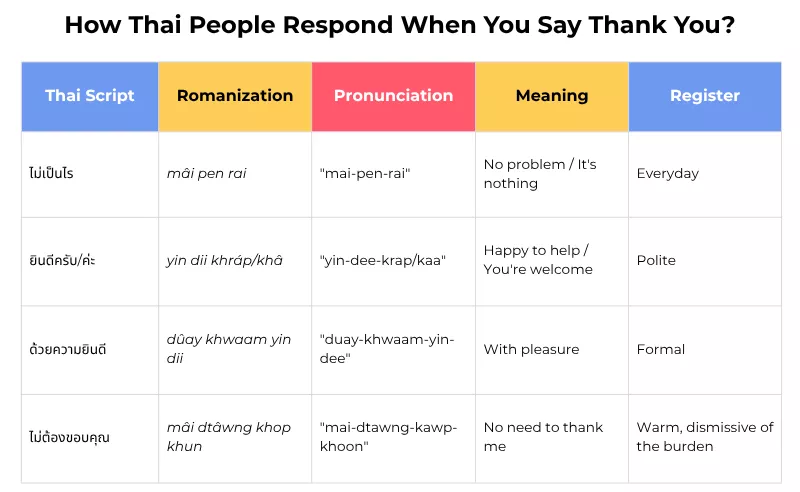
Use yin dii khráp/khâ when you want to sound warm and professional; it’s common in customer service and polished social settings. Save dûay khwaam yin dii for formal or written contexts, such as business letters or speeches. Mâi pen rai is the everyday default and the most distinctively Thai response of all: it captures the national philosophy of not burdening others with obligation, and using it yourself signals real cultural fluency.
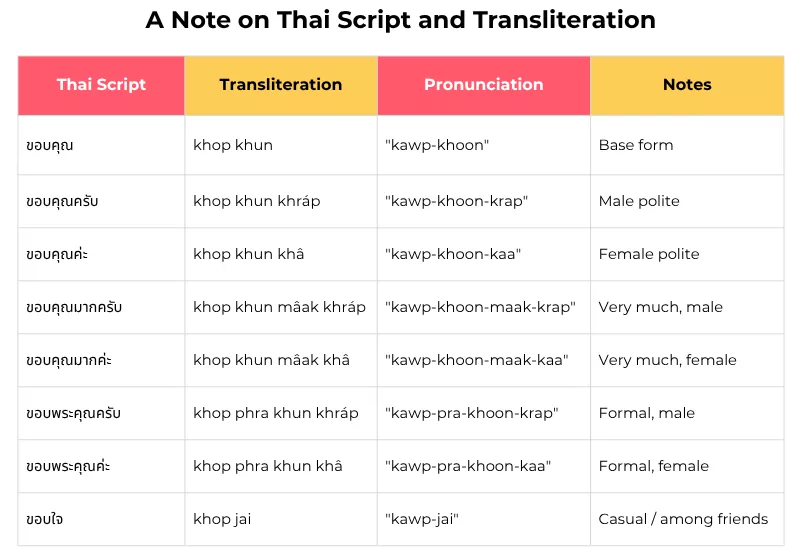
A Note on Thai Script and Transliteration
Below is thank you in Thai script with English transliteration for every form covered in this guide, a quick reference you can screenshot before your trip. If you plan to use Thai beyond a few tourist phrases, learning the script is worth the effort: it unlocks tone markers and gives you direct access to dictionaries and menus.
Thai’s tonal and contextual layers also make it one of Southeast Asia’s most nuanced languages, which is why, for anything beyond travel phrases (contracts, certificates, official letters), professional certified translation services are worth the investment.
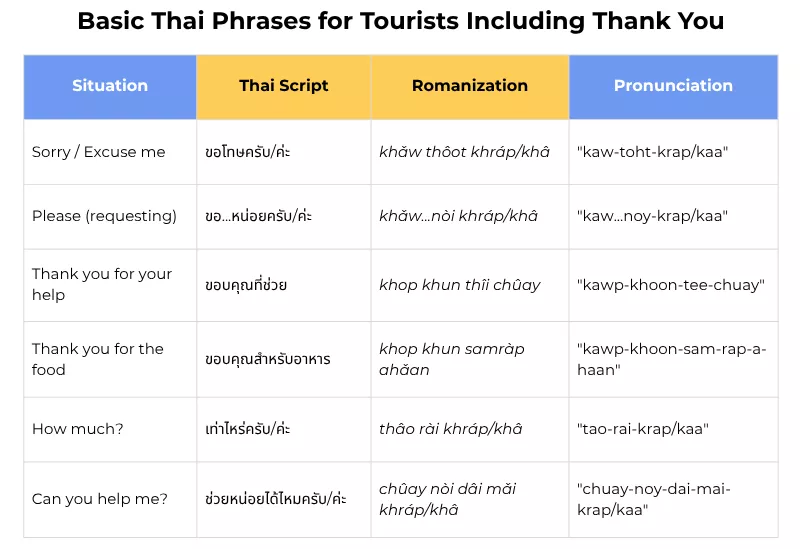
Basic Thai Phrases for Tourists Including Thank You
Knowing how to say thank you is a starting point. These Thai gratitude phrases for travelers will help you sound natural in real interactions, not just at tourist sites, but in everyday moments like local markets, guesthouses, and street food stalls. These are also the most practical polite expressions in Thai language a visitor can carry. These six phrases cover the situations where knowing just thank you isn’t enough – and each one takes under a minute to learn.
Expressing thanks in Thailand is more than a linguistic transaction; it is a bridge to the country’s famous “Land of Smiles” culture. By choosing the right phrase and pairing it with the appropriate social cues, you transform a simple interaction into a moment of genuine connection. Whether you stick to the polite Khop khun or embrace the casual Khop jai, your effort to honor Thai customs will always be met with appreciation.
The beauty of Thai gratitude lies in its flexibility, from the rhythmic tones of the spoken word to the silent grace of a Wai. As you move through your journey, remember that while your pronunciation might not be perfect, your sincerity will be perfectly understood. If you remember nothing else from this guide: men say ขอบคุณครับ (khop khun khráp), women say ขอบคุณค่ะ (khop khun khâ), and when in doubt, smile. The smile is the part Thai people will always remember.
Frequently Asked Questions
Q1. Can a female speaker use ครับ (khráp) or a male speaker use ค่ะ (khâ)?
No. These particles are gender-coded and tied to the speaker’s own gender, not the listener’s. Using the wrong one would sound jarring to any Thai person. Foreigners occasionally make this error without consequence, but correcting it quickly is worth it.
Q2. Does the age of the person you're thanking affect which phrase you use?
The age of the listener primarily affects whether you add a wai gesture and whether you escalate to ขอบพระคุณ (khop phra khun). The base phrase ขอบคุณ with the appropriate gender particle covers most situations regardless of the listener’s age.
Q3. Is it rude not to wai when saying thank you?
Not at all in casual settings. The wai is reserved for situations that carry genuine weight – extraordinary help, formal contexts, significant age or status differences. Using it constantly diminishes its meaning. Foreigners are never expected to wai, but doing so sincerely at the right moment always lands well.
Q4. How do you say "thank you" in a Thai text message or chat?
แต้งกิ้ว (dtâeng gîw) is extremely common in Thai digital communication – it’s a phonetic transcription of the English “thank you.” You’ll also see ขอบคุณนะ or just ขอบคุณ with emoji. The formal particles are often dropped entirely in casual texting, just as in English.
Q5. Are there regional variations in how thank you is said across Thailand?
The standard Central Thai phrases used in this guide are understood everywhere. However, in the North (Chiang Mai area), you may hear ขอบใจ๋ (khop jai, with a rising particle unique to Northern Thai dialect). In the Northeast (Isan), phrases follow Lao-influenced patterns. Visitors sticking to standard Thai won’t encounter any misunderstanding anywhere in the country.
Q6. Does Thai have a separate phrase for thanking someone in writing vs. speech?
Not structurally, the same phrases work in both contexts. However, formal written Thai (official letters, business correspondence) tends to use ขอบพระคุณ or ขอขอบคุณ (khǎw khop khun, a slightly more formal construction meaning “I would like to express thanks”). Spoken Thai rarely uses this form.

