 info@rushtranslationservices.com
 +1-559-742-0021
Getting your foreign-language documents accurately translated is very important for immigration paperwork. One single mistake, be it a mispelled name or a missing stamp, can lead to application rejection. Even if it is not rejected, you may receive a notice for Request for Evidence.
RFE can lead to double expenses, time waste, and missed opportunities. Plus, the United States Citizenship and Immigration Services, or USCIS requires certified translations to be done by professionals only. In this article, we will broadly discuss the USCIS Translation requirements. Keep reading to become fully informed.
Key Takeaways
- USCIS requires certified translation for non-English documents
- Translation of immigration documents must be submitted with a certificate of accuracy.
- Self-translated copies are not accepted. Only professionally translated documents with a signed statement are legally valid for official acceptance
- The translated document must be an accurate rendition of the original document. Format, layout, and content structure should be well-mirrored.
- Professional translator service providers ensure compliance with USCIS translation standards. They also ensure an acceptance guarantee, quality, and fast turnaround.
What Is USCIS Translation?
USCIS translations are basically certified translations. They come with a signed and stamped certificate of accuracy.
Now, what Is a Certificate of Accuracy? It is a signed statement of the translator stating that the translated document is a complete and accurate rendition of the original document. Only a certified professional translator can offer this certification statement. This is one of the major requirements for USCIS approval.
USCIS Translation Requirements for Immigration Documents
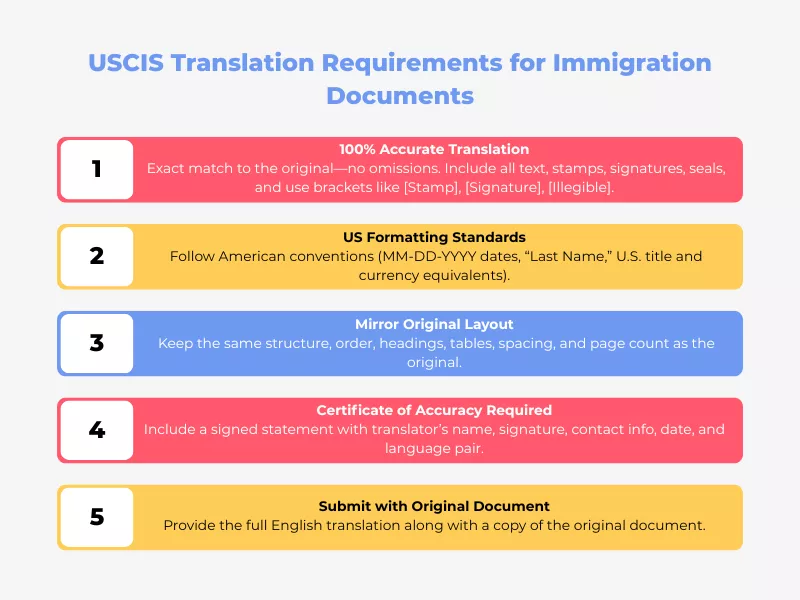
Your document translation must meet USCIS requirements for a smooth immigration process. Here are the important USCIS document translation requirements:
1. Accurate Translation of Personal, Official, or Legal Documents
Your translation for USCIS must be accurate in all aspects while meeting all legal translation requirements. The immigration document translation should match the source document without fail. There should be no detail mismatch with the original content exactly.
Let’s take a marriage certificate translation, for example. The spelling of the partners’ names must be accurate.
Also, all visible elements of the original doc alongside the text should be present. For example:
- Use [Square Brackets] for non-translatable elements. Examples include [Stamp], [Signature], [Barcode], [Watermarks], or [Illegible].
- Also, include faded marks or handwritten notes. Do not skip adding symbols and minor markings. Always acknowledge the unclear text properly.
When you translate documents for USCIS, avoid speculative or descriptive explanations. Only record what is clearly visible.
Remember, every detail, both textual and visual, plays a role in verification. They confirm authenticity and completeness for the certified translation for USCIS documents. They have a few requirements for illegible text in translation as well, make sure to go through them.
2. Translation Must Follow the American Convention for Formatting
The formatting of Document translation for USCIS should meet federal expectations. For this, you have to follow standard US practices for formatting. For example:
- In the translation process of birth certificates, the date format must be: MM-DD-YYYY.
- Use “Last Name”. Do not use regional terms like “Surname.”
- Adjust currencies to local monetary terms.
- Use US equivalents for Academic titles in diplomas.
- Governmental titles should also reflect American terminology.
The goal is clarity and allowing officers to review immigration applications efficiently.
3. Translated Document Must Mirror the Structure and Layout of The Original
Ensure your certified translations for USCIS mirror the original document visually. The requirements are:
- Maintain the original content order in the translated USCIS version, too. This means sections appear in the same sequence. Also, the translated is layout matching the original structure.
- Also, reserving spacing, headers, and tables is essential.
- Maintaining original page count for USCIS certified translations.
- Whenever possible, maintain consistent page breaks.
USCIS reviewers often review documents line by line. Text placement and meaning should be consistent. Maintaining layout helps organized presentation. It is important for structural integrity for USCIS official translation to save yourself from document rejection by government agencies.
Credibility and clarity speed up the comparison and verification of information. This reduces the risk of misunderstandings or confusion.
4. Must have a Certificate of Accuracy
As per the USCIS guidelines, the presence of a Translation Certification is non-negotiable. The Certificate of Accuracy must include:
- A signed declaration attesting to the accuracy of USCIS translated documents
- Credentials (name and signature) and contact information of the translator
- The date of the documents translated
- The language pair (e.g., Arabic into English)
This USCIS translation certification statement validates the translated documents. It is essential for official usage and legal acceptance.
5. Full English Language Translation must Accompany Original Documents
You have to submit a USCIS certified translation along with the original documents. Reviewers will cross-check the authenticity of the certified English translation. They do so by comparing it with the original documents.
Who Can Translate Documents for USCIS?
Only professional translators can provide a certified translation for USCIS. They must be fluent in English and the source language. Only professional translators or translation service providers can authenticate the translation. They can only provide a USCIS translation certificate.
Can I Translate My Own Documents for USCIS?
No! Self-translated or machine-translated documents are not accepted by USCIS. The reasons are upholding integrity and impartiality. The documents must be translated by professional human translators. Non-compliant translation leads to outright rejection or delays due to RFE issuance.
Why You Should Hire a Professional Certified Translation Service for USCIS Acceptance?
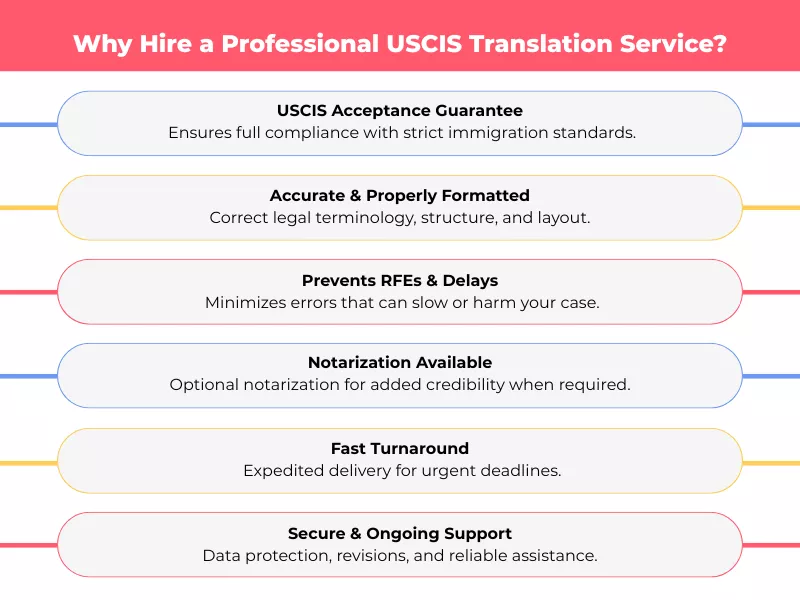
Applying for a US visa, green card, or filing for citizenship? Then translation needs will definitely arise for every document not originally in English. In this case, hiring an expert provider of language services is recommended. Major benefits are:
Offer an Acceptance Guarantee
USCIS enforces strict translation requirements. A professional USCIS translation company understands these USCIS translation standards fully. A uscis certified translator improves accuracy and compliance. A great translation reduces risks during immigration review.
Quality Assurance in the Translation Process
Experts follow proper formatting guidelines, and the translations meet USCIS standards exactly. Structure and layout are carefully prepared. Also, immigration language requires precise wording. Professionals handle legal and technical terminology correctly while avoiding interpretation errors.
RFE Avoidance
Avoiding costly delays is extremely important. Even minor errors may trigger a Request for Evidence. An RFE can delay your case for months. In serious cases, applications may be denied. DIY translation vs professional companies that specialize in immigration documents and provide error-free work. They ensure accurate and consistent submissions. This keeps applications moving forward smoothly.
Helps with Notarization for Certified Translations for Any Documents
Sensitive submissions may require translations to be notarized. However, this is not always mandatory in the US. But notarization can add credibility when required and increase reviewer confidence. Professional USCIS translation services can provide notarization upon request.
Faster Turnaround
Faster processing is another major advantage. Time-sensitive filings require a quick turnaround. Many certified USCIS translation services offer expedited delivery. Some translations are completed within twenty-four hours. This helps meet urgent USCIS deadlines.
Continued Assistance
Peace of mind is equally valuable. Best USCIS translation service providers maintain security for data protection. 24/7 Customer support is available for questions. Applicants gain reassurance through professional oversight. You can also avail editing, revision, or expert reviews for error minimization.
Get Your USCIS Translation Approved with Rush Translation Services
Looking for a reliable provider of uscis approved translation services? Rush Translation Services offer uscis translation services. Here, you can hire USCIS translators to get the job done.
Our expert translators are native speakers and competent to translate any documents. They are also well-versed with uscis document translation policy standards to offer the best results!
The expertise of the translation team ensures accuracy and completeness of the translation. You get proper USCIS translation format and structure every time!
Whether you need a birth certificate or a passport translation, we are here to do the task! Contact us now for USCIS-approved translation services!
Frequently Asked Questions
Q1. What is the USCIS Certified Translation Validity Period?
USCIS translation documents do not have expiration dates. Also, a certificate of translation for USCIS is considered valid indefinitely. This remains true if the original document is unchanged. Such USCIS-accepted translations can usually be reused. They even support multiple immigration applications.
Q2. Why Does USCIS Require Strict Translation Standards?
USCIS processes thousands of immigration applications daily. Many applications include documents in different languages. Officers must review materials efficiently and accurately. To ensure consistency and fairness, strict standards exist. These standards apply to all documents in languages other than English. A certified translation requires more than language accuracy. Certified translations meet structural requirements as well. Complying with USCIS translation format reduces bias during evaluations. It also minimizes confusion in case reviews.
Q3. Is the final review important even if an expert translator did the work?
Yes! Reviewing the professionally translated documents adds a layer of extra assurance. One must not skip it!
Q4. How do I verify if a translation service or translator is officially recognized or accepted by USCIS?
There’s no direct or formal way to recognize a uscis approved translators. There’s also no such list of approved translation agencies available. However, having a thorough interview with the translator or provider can clarify doubts.
Q5. When is notarization of a translation required, and how do I request it if needed?
USCIS almost never requests notarization; translation certification is enough. However, it may be requested by other authorities during the immigration process, especially if you are involved in legal or adoption-related court or academic matters. In that case, your respected authority will send your notarization requirement.
Q6. What is the typical cost range for certified translations for USCIS?
Translating documents for USCIS typically cost $22 per page. This applies to common languages primarily. Costs depend on language rarity and result in increased pricing. Document complexity also affects total cost. Urgent requests increase the overall fee. Rush services may add $10 to $20. This additional charge usually applies per page.
To reduce expenses, avoid rush processing. Choose standard turnaround times whenever possible. Select providers offering flat-rate pricing structures.
Q7. Can I reuse a certified translation for multiple applications or future filings?
Yes! You can reuse certified translations for multiple applications or future filings.
Q8. What are the exact steps to submit a certified translation with my USCIS application?
Log in to your USCIS online account. Go to the “Evidence” section of your application. Upload a single PDF file. This PDF file must contain high-quality scans of
- English translation
- The certificate of accuracy
- The Original Document scan

